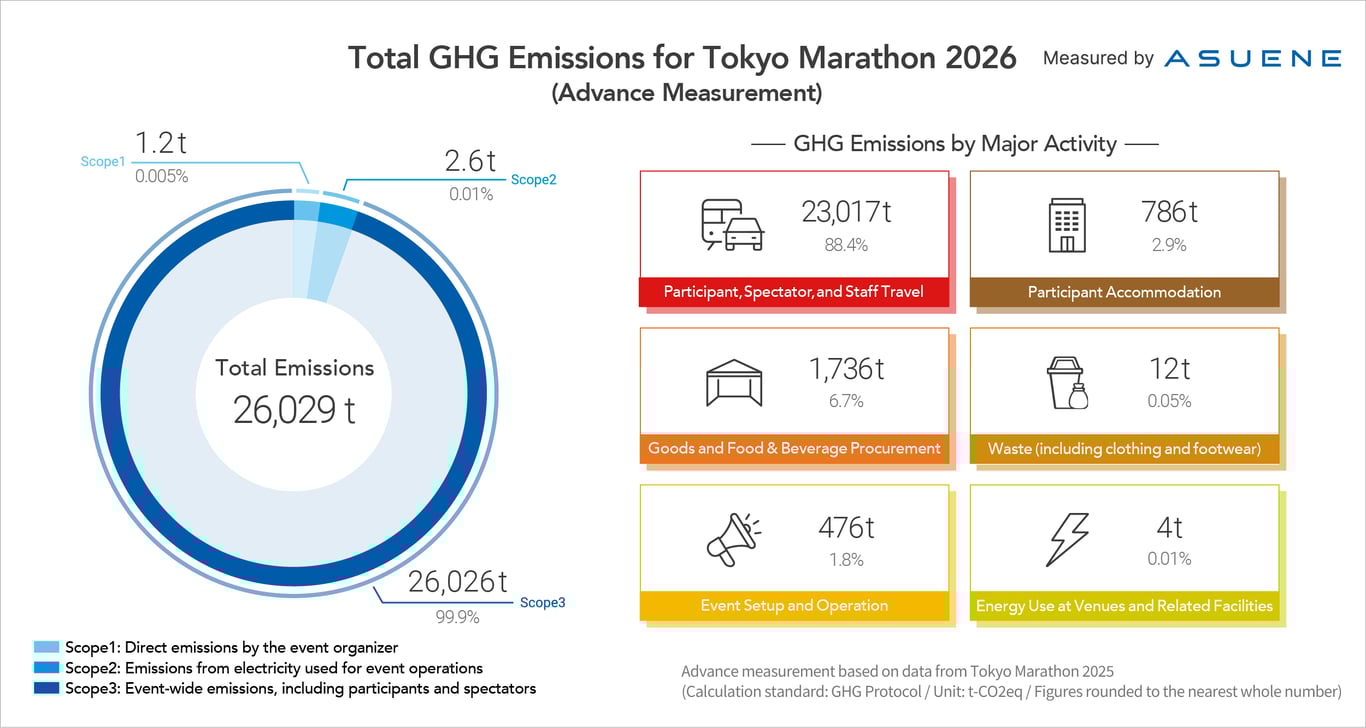
ASUENE Inc., in collaboration with the Tokyo Marathon Foundation, has conducted a pre-event measurement of total GHG emissions associated with the operation of Tokyo Marathon 2026. This initiative represents the first milestone of a three-year sustainability partnership spanning from 2026 to 2028.
The measurement estimates total GHG emissions for the event at 26,029 t-CO2.
Conducted in accordance with the GHG Protocol, the measurement covers not only direct emissions by the organizer, but also emissions related to the travel and consumption behaviors of runners, spectators, and event staff.
As a result, Tokyo Marathon 2026 becomes the first marathon event in Japan to comprehensively organize and disclose total GHG emissions across Scope 1, 2, and 3.
By visualizing and transparently disclosing the event’s carbon footprint, ASUENE and the Tokyo Marathon Foundation aim to establish a robust and credible foundation for sustainable event management.
CO2 Emissions Measurement Results for Tokyo Marathon 2026
As part of its commitment to sustainable event operations, the Tokyo Marathon quantified and disclosed total GHG emissions across the entire event.
While quantitative disclosure of environmental impact for marathon events is still at an early stage in Japan, this initiative places particular emphasis on presenting Scope 1-3 emissions in numerical terms for a large-scale international marathon. This approach underscores the importance of comparability and transparency in evaluating the environmental impact of major sporting events.
Based on data from the Tokyo Marathon 2025*, ASUENE conducted a pre-event measurement of total GHG emissions for Tokyo Marathon 2026. With the cooperation of the event organizer and operating partners, emissions associated with participant and stakeholder travel, waste treatment, and energy consumption were quantified in advance.
As a result, total GHG emissions for the event were estimated at 26,029 t-CO2.
* Tokyo Marathon 2025: approximately 38,000 runners
<GHG Emissions by Scope>
Total emissions: 26,029 t-CO2
・Scope 1 (Direct emissions by the organizer): 1 t-CO2
・Scope 2 (Emissions from electricity used for event operations): 3 t-CO2
・Scope 3 (Event-wide emissions including participants and spectators): 26,026 t-CO2
<Breakdown by Major Activity>
・Travel by participants, spectators, and event-related personnel: 23,017 t-CO2 (88.4%)
・Participant accommodation: 786 t-CO2 (2.9%)
・Procurement of goods and food & beverages: 1,736 t-CO2 (6.7%)
・Waste, including cold-weather clothing and footwear: 12 t-CO2 (0.05%)
・Event setup and operational services: 476 t-CO2 (1.8%)
・Energy use at venues and related facilities: 4 t-CO2 (0.01%)
* All figures rounded to the nearest whole number.
The largest source of emissions was human mobility, including travel by runners, spectators, and event staff, accounting for approximately 88.4% of total emissions. This result demonstrates that the carbon footprint of a marathon event is shaped not only by the organizer, but also by the collective choices and behaviors of a large number of individuals.
Demonstrating Leadership in Sustainable Event Management as a member of World Marathon Major
Globally, large-scale events are increasingly measuring, disclosing, and working to reduce their environmental impact. International sporting events, in particular, generate significant GHG emissions through transportation, logistics, and energy use associated with venue operations.
Tokyo Marathon is one of the world’s largest international marathons, welcoming approximately 39,000 runners (2026), supported by around 10,000 volunteers, and attracting nearly one million spectators along the course. As with other mass-participation events of this scale, travel, attendance, and operational activities account for a substantial share of total emissions.
This measurement was designed to meet a level of disclosure comparable to other World Marathon Majors. For example, the Berlin Marathon has publicly reported total GHG emissions of approximately 25,950 t-CO2, including Scope 3 emissions and key emission drivers.
To ensure comparability with such international benchmarks, Tokyo Marathon 2026 conducted an advance measurement based on the GHG Protocol, enabling transparent and globally aligned disclosure of emissions across the entire event.
Making the Positive Impact of Marathons on People and the Planet Visible to Inspire Action
should not remain an initiative limited to organizers alone. Instead, it should serve as an opportunity for individuals to reflect on the connection between everyday life and climate change.
At Tokyo Marathon 2026, approximately 39,000 runners will each run 42.195 km, covering a combined distance of about 1.645 million kilometers using only human power—equivalent to circling the Earth approximately 41 times.
If the same distance were traveled by gasoline-powered vehicles, it would generate an estimated 230 t-CO2. Running itself is inherently one of the lowest-impact forms of mobility.
This initiative represents a first step in clearly communicating two important perspectives:
Running is not only beneficial for health, but also an environmentally friendly action; at the ssame time, small changes in travel choices and everyday behavior can significantly reduce GHG emissions associated with large-scale events.
To ensure that the Tokyo Marathon continues to deliver a positive message—that running is good for people and for the planet—accurately understanding and communicating environmental impact is essential.
Runners, spectators, volunteers, and organizers alike: each individual choice contributes to a more sustainable marathon.
Looking ahead, ASUENE and the Tokyo Marathon Foundation plan to progressively implement emissions-reduction measures related to mobility, carbon offset initiatives, and enhanced recycling and upcycling efforts. Together with runners, spectators, and the city of Tokyo, they aim to expand this challenge—creating a future where we can keep running—from Tokyo to the world.
Asuene Company Profile
Asuene Inc. is a leading Climate Tech company in Japan with the mission of ”Changing the world for the next generation”. We provide “ASUENE”, a carbon accounting platform to measure, report and reduce carbon emissions of companies and we contribute to the net zero society.
This press release has also been published on VRITIMES
Author

Clara@gmail.com
Related Posts
Allianz Insurance Singapore Introduces Outpatient Reimbursement Benefit for Policyholders Affected by Haze
- 0
- 577 words
For over a month now, Singapore residents have been navigating the effects of prolonged haze conditions. Beyond reduced visibility and the familiar...
Read out allSanct Social releases Episode 7, a short film about keeping two weeks with family close after the flight home
- 0
- 881 words
Sanct Social, the Singapore-registered social app for close friends and family, released Episode 7 of its short film series on YouTube on...
Read out allWhat Does Hospitalisation Really Cost in Singapore? It’s More Than Just the Medical Bill
- 0
- 1,106 word
Hospital costs in Singapore continue to climb. Rising manpower costs driven by staff shortages, increasing drug prices, supply chain pressures, and growing...
Read out all
KAI Logistik Sabet 4 Penghargaan di Ajang Anugerah Humas Indonesia 2026
- 0
- 617 words
KAI Logistik, anak usaha PT Kereta Api Indonesia (Persero) yang bergerak di bidang jasa logistik, kembali mencatatkan prestasi melalui kinerja kehumasan dengan...
Read out allNeuron Digital becomes first smart technology company globally to achieve BSI Kitemark™ for Digital Twins
- 0
- 1,402 word
Neuron Digital has received the BSI Kitemark™ for Digital Twins which is an independent assurance for trusted, secure and outcome-driven digital twins...
Read out allFriends on Sanct Social are added by meeting in person: Episode 6 follows one day in Jakarta with friends from Singapore and Malaysia
- 0
- 1,036 word
Sanct Social, the Singapore-registered social app for close friends and family, released Episode 6 of its short film series on YouTube on...
Read out all