- 0
- 598 words
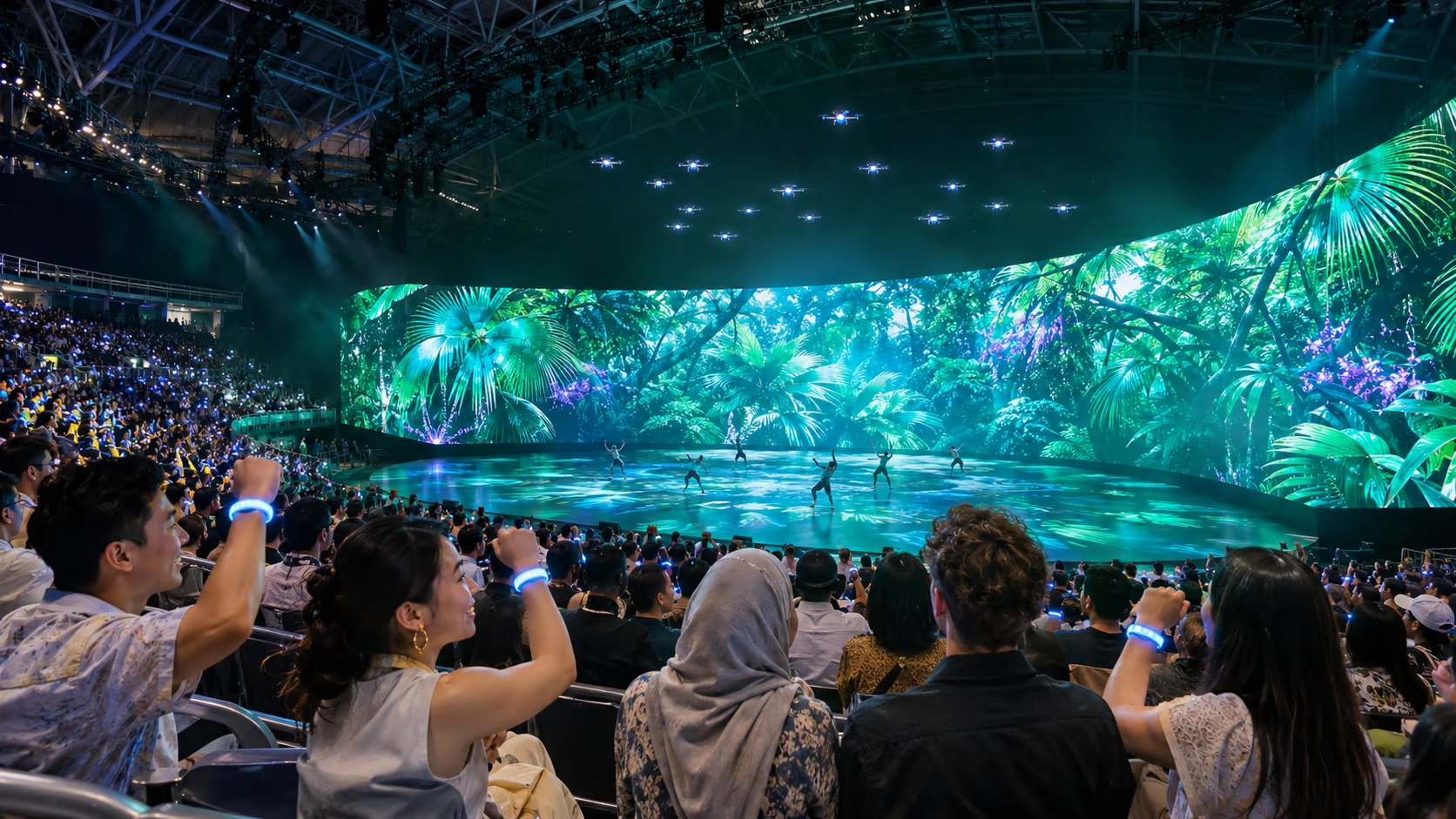
The National Stadium, with its cavernous dome and 55,000-seat capacity, has always been a difficult venue for intimate storytelling. In 2026, Singapore’s National Day Parade creative team turned that constraint into an advantage. The production introduced the stadium’s first indoor drone light show, deploying 300 drones beneath the dome in synchronization with aerial acrobatics and a live performance by singer Jasmine Sokko . Because indoor drones cannot rely on GPS signals, the team implemented beacon-based positioning technology—a technical workaround that has since become a case study for other indoor venues considering similar productions .
Beyond the Drone Spectacle
The NDP’s technical ambitions extended well beyond the drone swarm. The stage itself measured 162 meters in length and 74 meters at its widest point, equipped with six elevators and eight passageways to enable rapid performer movement . The production deployed 1,600 moving lights, approximately 50 lasers, and 170 special effects units. Audience wristbands, upgraded from previous years, displayed text and graphics, effectively making the crowd a low-resolution display surface .
Colonel Ng Ching’un, chairman of the parade’s executive committee, framed the design philosophy in terms that resonate across the live events industry: “As an immersive performance, we want the audience to be shocked the moment they step into the stadium” . That objective—shock as a design outcome—requires productions to think in three dimensions, incorporating ceiling space, audience wearables, and spatial audio rather than treating the stage as the sole focal point.
The Pipeline Behind the Spectacle
Singapore’s live entertainment market, valued at USD 1.29 billion in 2025, is projected to reach USD 2.08 billion by 2034 . Music concerts represent the largest event type, but festivals are expected to grow fastest . The 2026 calendar reflects that momentum. Concert promoter LAMC Presents reported six shows already on sale early in the year, with bookings extending into 2027 and artists planning tours two to three years in advance .
Ross Knudson, LAMC’s co-founder, noted that venue scarcity is pushing organizers toward unconventional spaces. “We’ve kind of run out of venues at the moment, and we’re looking for all kinds of solutions out there—might be a grass patch or something, a park,” he told Channel NewsAsia . That pressure to find new spaces creates openings for immersive productions that do not require traditional proscenium stages.
The Reliability Premium
Analysts attribute Singapore’s live events strength not only to infrastructure but to predictability. Christopher Khoo of tourism consultancy MasterConsult Services observed that global uncertainties have made organizers more selective, and Singapore’s reputation for safety and reliability stands out: “We are unlikely to experience fallout from any US-China disturbances, or any other kind of disturbances” . For international touring productions carrying seven-figure technical budgets, that reliability is worth as much as the venue itself.
The implication for immersive entertainment is significant. Singapore is not competing solely on the basis of better screens or faster processors. It is competing on the ability to execute complex, technology-heavy productions without the logistical disruptions that plague other regional markets. When a promoter knows that 300 indoor drones will fly without regulatory delays and that RFID wristbands will function across 55,000 attendees, the calculus for investing in ambitious immersive formats shifts decisively in Singapore’s favor.
The next frontier is permanence. Pop-up immersive experiences and one-off stadium spectacles generate headlines, but the venues that will define the next decade are those that embed interactivity into their everyday operations. Exploria, with its 80-plus permanent interactive installations, is one model. The National Stadium, with its proven capacity for dome-based drone choreography, is another. Between them, Singapore is building an infrastructure for immersion that does not depend on the next blockbuster IP.
Author

Clara@gmail.com
Related Posts
From Lunch to Last Call: The Hybrid Venues Blurring Singapore’s Day and Night
- 0
- 459 words
One Address, Four Dayparts The traditional night out in Singapore has always involved friction: dinner in one place, drinks in another, a...
Read out all
Generation Sober: How Gen Z Is Replacing the Club Queue with the Coffee Queue
- 0
- 477 words
The S$100 night out vs. the S$20 afternoon For many young Singaporeans, the decision to skip the nightclub is not ideological—it is...
Read out all
Singapore’s Help-to-Buy Ticketing Boom Tests the Limits of Consumer Protection in a Scam-Prone Market
- 0
- 789 words
A Grey Zone Between Service and Scalping Help-to-Buy (HTB) ticketing occupies an uncomfortable space in Singapore’s consumer landscape. It is not ticket...
Read out all
Inside The Kallang’s Strategy to Become Asia’s Premier Concert Destination
- 0
- 427 words
From Sports Hub to Entertainment Powerhouse The National Stadium at The Kallang has hosted Taylor Swift, Coldplay, and Blackpink in recent years....
Read out all
Beyond K-Pop: The K-WAVE × AIGC Alliance and Singapore’s Role in AI-Driven Asian Entertainment
- 0
- 476 words
A Trilateral Bet on the Future of Content At the 20th Busan Content Market in June 2026, a quiet signing ceremony took...
Read out all
The Rise of Independent Artist Management in Singapore: Tasha Low and the New Autonomy Model
- 0
- 606 words
A Defining Moment in Singapore’s Talent Management Landscape When Tasha Low announced her departure from WILD Entertainment Group in August 2026 after...
Read out all