- 0
- 459 words
One Address, Four Dayparts
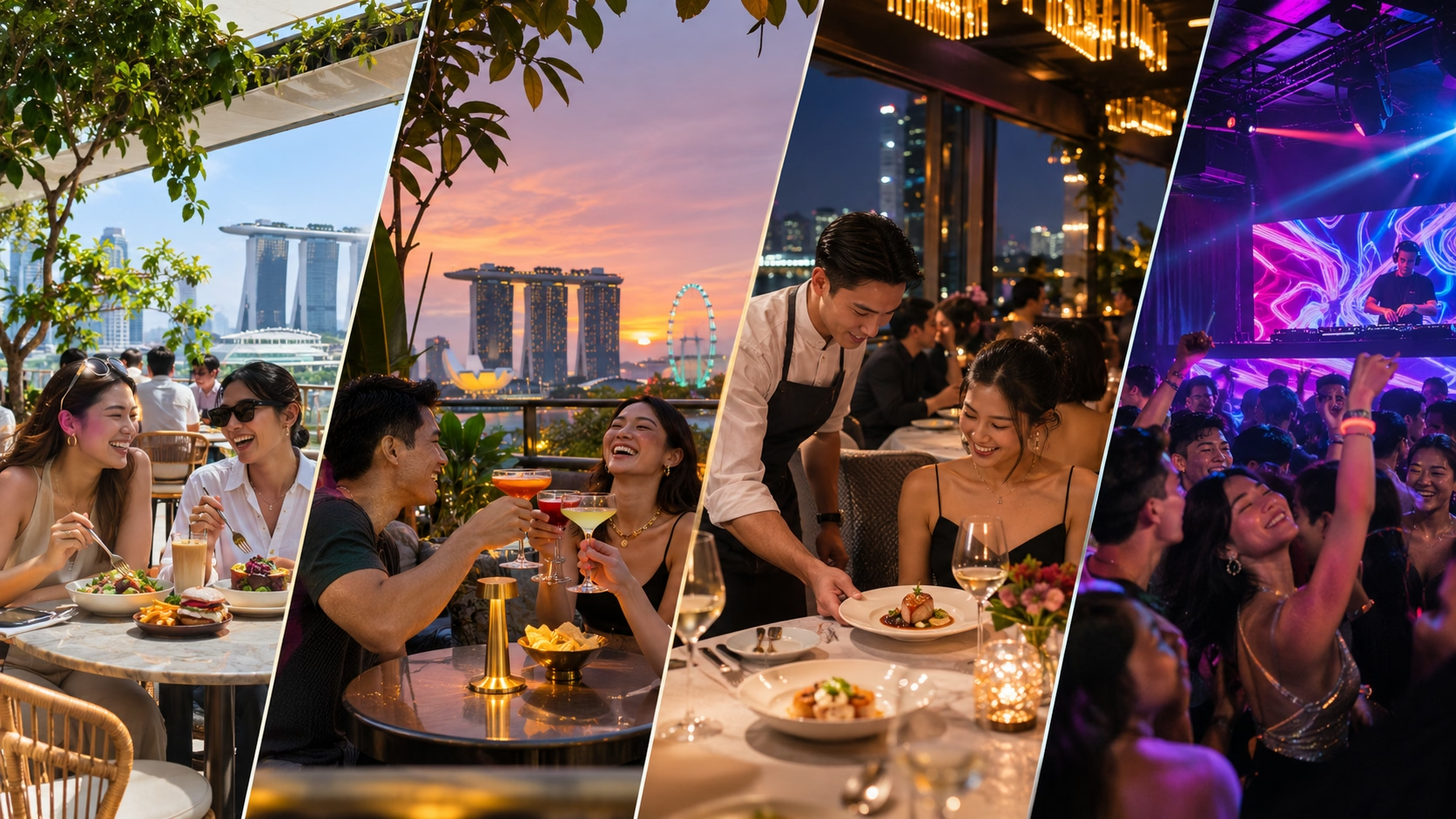
The traditional night out in Singapore has always involved friction: dinner in one place, drinks in another, a club somewhere else, and a taxi ride between each. Milli, the two-storey rooftop concept at National Gallery Singapore, is built to eliminate that friction. It opens at 11am for lunch, shifts into sundown drinks from 3pm, transitions to dinner at 5.30pm and dissolves into a late-night lounge that runs until 4am on weekends. The ambition is not simply to serve different menus at different hours. It is to make the entire evening — and, increasingly, the entire day — a single continuous experience.
The Milli Model: Dinner, Drinks, Dance
Milli’s layout reflects that ambition physically. The upper level houses a sky dining and bar; one floor below, a high-energy club lounge draws on the DNA of Bae’s Cocktail Club, with a Funktion-One sound system and immersive LED installations. Guests move between floors as the night progresses, and shuttle buses connect the venue to Bae’s Cocktail Club in Tanjong Pagar on Friday and Saturday nights. The operational complexity is considerable — multiple kitchens, separate service teams, soundproofing, licensing — but the customer-facing result is a venue that behaves less like a restaurant and more like a self-contained entertainment district.
Rally Clubhouse and the Coffee-to-Cocktail Pipeline
Zouk’s Rally Clubhouse applies the same logic at a smaller scale. The 120-seat space at The Cannery in Clarke Quay is a café by day, a bar by night and a music venue when the decks come alive. Its programme includes open-deck sessions, DJ academy workshops, listening parties and live vocal sets, alongside flea markets and community gatherings. The strategic purpose is twofold: it generates revenue during hours when the adjacent club venues are closed, and it builds a relationship with guests before they ever step into the Mainroom. In a market where nightlife operators are testing day-to-night programming to stay relevant, Rally is a low-risk entry point into the Zouk ecosystem.
Operational Realities of the Hybrid Model
Hybrid venues are not simply clubs with better coffee. They require separate licensing, different staffing rosters, distinct supply chains and a brand that can credibly occupy multiple cultural spaces without feeling incoherent. Milli succeeds because its culinary credentials — a Michelin-starred chef, a celebrated bartender, a proven cocktail-club team — give the daytime offering its own reason to exist. Rally succeeds because Zouk’s music credibility gives its evening programming authenticity. The lesson for operators is that hybridity only works when each daypart can stand on its own. The venue is not a club with a café attached, nor a restaurant with a dance floor. It is a single address engineered for a city that no longer wants to move between destinations to complete a night out.
Author

Clara@gmail.com
Related Posts
Generation Sober: How Gen Z Is Replacing the Club Queue with the Coffee Queue
- 0
- 477 words
The S$100 night out vs. the S$20 afternoon For many young Singaporeans, the decision to skip the nightclub is not ideological—it is...
Read out all
Singapore’s Help-to-Buy Ticketing Boom Tests the Limits of Consumer Protection in a Scam-Prone Market
- 0
- 789 words
A Grey Zone Between Service and Scalping Help-to-Buy (HTB) ticketing occupies an uncomfortable space in Singapore’s consumer landscape. It is not ticket...
Read out all
Inside The Kallang’s Strategy to Become Asia’s Premier Concert Destination
- 0
- 427 words
From Sports Hub to Entertainment Powerhouse The National Stadium at The Kallang has hosted Taylor Swift, Coldplay, and Blackpink in recent years....
Read out all
Beyond K-Pop: The K-WAVE × AIGC Alliance and Singapore’s Role in AI-Driven Asian Entertainment
- 0
- 476 words
A Trilateral Bet on the Future of Content At the 20th Busan Content Market in June 2026, a quiet signing ceremony took...
Read out all
The Rise of Independent Artist Management in Singapore: Tasha Low and the New Autonomy Model
- 0
- 606 words
A Defining Moment in Singapore’s Talent Management Landscape When Tasha Low announced her departure from WILD Entertainment Group in August 2026 after...
Read out all
Beyond the Headset: Location-Based VR Redefines Narrative Entertainment in Singapore
- 0
- 500 words
HavenXR: Where Cinema Meets Gaming Singapore has long positioned itself at the intersection of entertainment, innovation, and technology. The next evolution of...
Read out all