- 0
- 477 words
A Landmark Partnership for Asian Cruising
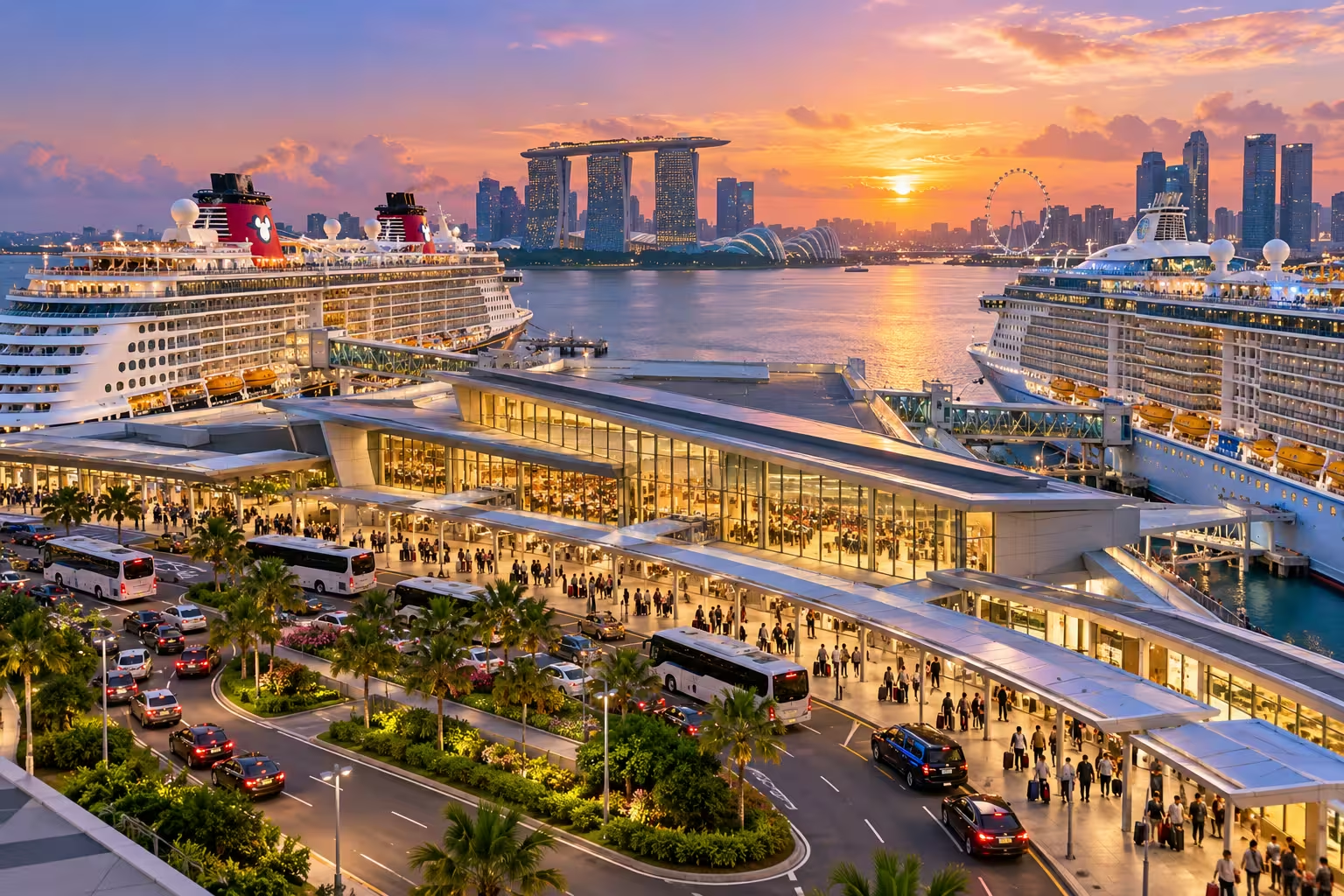
In May 2026, the Singapore Tourism Board and Princess Cruises announced a three-year partnership that represents one of the most significant commitments to cruise tourism in Southeast Asia. Spanning 2027 through 2030, the agreement is expected to bring more than 150,000 passengers through Singapore while contributing substantial economic activity across the country’s tourism and maritime sectors. This collaboration serves as a blueprint for how cruise lines and destinations can build mutually beneficial, long-term relationships.
Multi-Ship Deployment Strategy
The partnership will see three Princess Cruises vessels—Diamond Princess, Sapphire Princess, and Grand Princess—operating from Singapore, with the number of sailings scheduled to double by 2030. The deployment follows the 2026-2027 season, during which Diamond Princess and Sapphire Princess will homeport simultaneously in Singapore between November 2026 and February 2027. This concurrent deployment demonstrates Princess Cruises’ confidence in sustained passenger growth and the market’s long-term potential.
Diverse Itineraries for Every Traveler
The expanded deployment offers itineraries ranging from 10 to 28 days, allowing passengers to access a broader range of destinations throughout Asia. The 2027-2028 Southeast Asia programme will feature Diamond Princess on extended regional voyages linking Japan, Korea, and Southeast Asia, encompassing 29 destinations across nine countries. Several sailings will be structured as longer-duration regional voyages of up to 28 days, catering to travelers seeking immersive, destination-rich experiences.
Attracting International Fly-Cruise Traffic
Singapore’s continued use as a seasonal homeport for Princess Cruises is anticipated to attract international fly-cruise traffic, particularly from medium- and long-haul source markets including Australia, the United Kingdom, and the United States. The deployment is expected to support further expansion of the fly-cruise segment in Asia, reinforcing Singapore’s role as a preferred embarkation hub supported by extensive international air connections and established cruise terminal facilities. Jean Ng, Assistant Chief Executive of the Experience Development Group at the Singapore Tourism Board, stated that the agreement reflects Singapore’s standing as a leading cruise hub in Asia and would broaden the range of premium cruise products available in the market.
Economic Ripple Effects
The partnership extends beyond cruise terminal operations. Increased cruise passenger arrivals stimulate demand for hotels, resorts, restaurants, local tours, and transportation services. Longer, multi-destination itineraries encourage higher traveler spending, longer stays, and repeat visits, generating employment and business opportunities in port cities. This multiplier effect reinforces the cruise industry’s role as a significant contributor to Singapore’s broader tourism economy.
A Model for Industry Collaboration
Matthew Rutherford, Vice President Asia Pacific at Princess Cruises, noted that Singapore represents a central component of the company’s regional strategy and provides an effective homeport for the expansion of its Asia-Pacific operations. The multi-year deployment reflects confidence in Singapore’s connectivity and cruise ecosystem while responding to increasing demand for longer and more destination-focused itineraries. This partnership exemplifies how strategic collaboration between cruise lines and destination authorities can drive sustainable growth in the Asian cruise market.
Author

Clara@gmail.com
Related Posts

Science Centre Singapore and KidsSTOP: Building Scientific Curiosity Through Play-Based Learning
- 0
- 408 words
A Legacy of Interactive Science Education Since its establishment, Science Centre Singapore has stood as the nation’s premier institution for hands-on scientific...
Read out all
Gardens by the Bay Photography in 2026: A Complete Visual Guide for Travellers
- 0
- 382 words
Gardens by the Bay has welcomed over 87 million visitors since its opening, cementing its status as Singapore’s premier horticultural and photographic...
Read out all
The Architectural Time Machine: Tracing Singapore’s Evolution Through Its Most Iconic Modern Structures
- 0
- 499 words
To walk through Singapore is to flip through the pages of a futuristic novel that actually came true. The city’s modern architecture...
Read out all
Eating Like a King on a Pauper’s Budget: The Backpacker’s Guide to Singapore Hawker Centres
- 0
- 608 words
The reputation of Singapore as one of the most expensive cities in the world often deters budget travelers, but there is a...
Read out all
Singapore Remote Work Visa Options 2026: Tech.Pass, EntrePass, and Work Holiday Pass Explained
- 0
- 494 words
Many digital nomads assume Singapore offers a dedicated digital nomad visa. It doesn’t. Instead, the city-state uses a suite of targeted passes...
Read out all
Singapore Medical Wellness Travel: Advanced Health Screenings and Integrative Recovery at World-Class Hospitals
- 0
- 412 words
A growing number of travellers are no longer visiting Singapore only for shopping or street food. They come for preventive healthcare. In...
Read out all