- 0
- 650 words
The Silent Drain on Singapore’s Healthcare Frontline
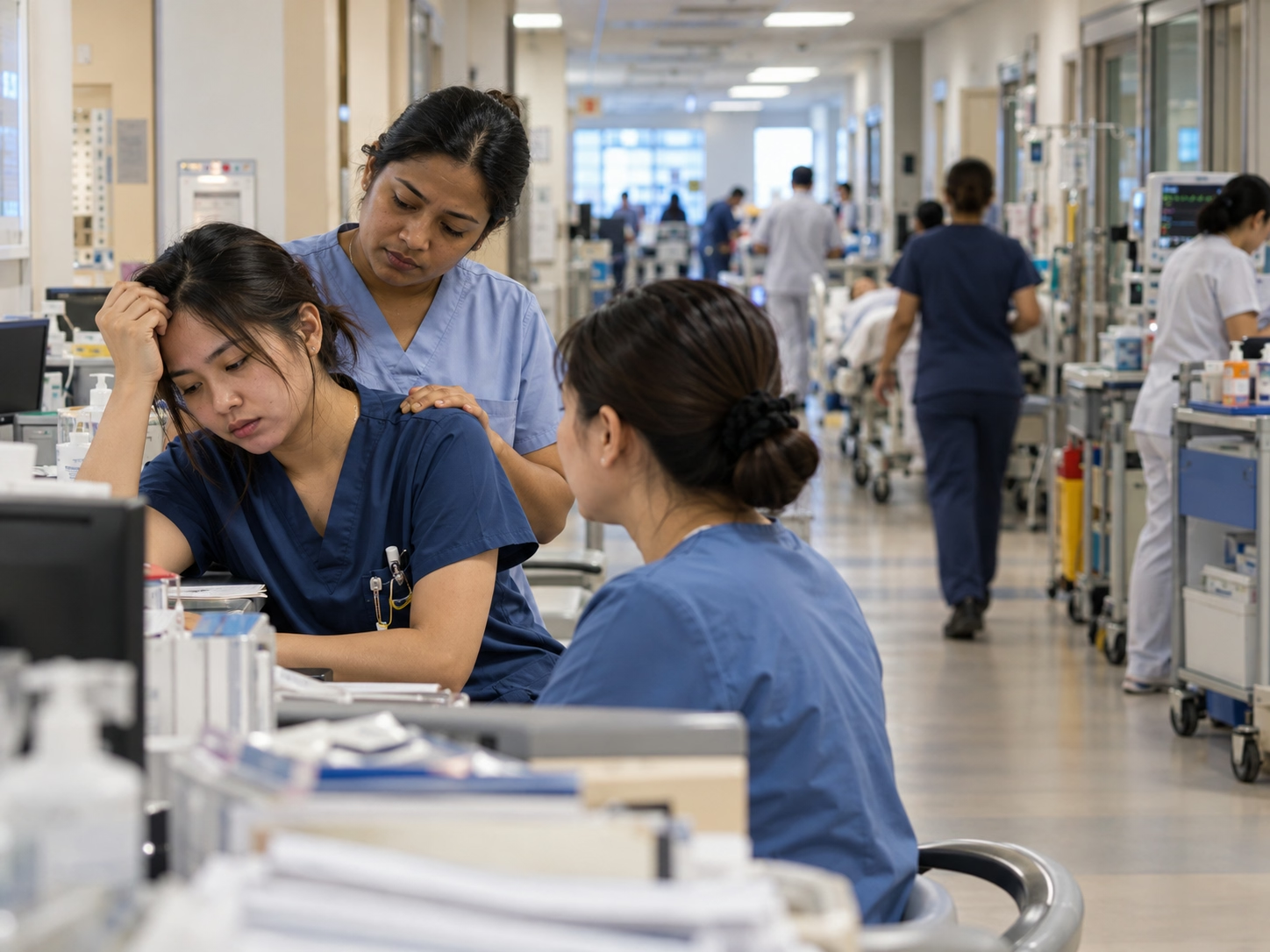
Behind the polished corridors of Singapore’s public hospitals, a quiet crisis is unfolding. Over half of nurses surveyed in a 2026 study reported considering leaving their organisation, while 36% were contemplating exiting the profession entirely. The drivers are neither mysterious nor easily dismissed: exhaustion (74%), inadequate staffing (72%), feeling undervalued (66%), low pay (61%), and excessive pressure (58%).
These are not abstract statistics. They represent individual professionals—many of them Singaporean-born, trained at local institutions—who are reaching a breaking point.
The Local Talent Paradox
Singapore’s nursing workforce tells a contradictory story. On one hand, the total number of registered nurses reached 50,389 in 2024, with record growth in newly registered and enrolled nurses. On the other, the proportion of Singaporean and permanent resident nurses has been declining, with foreign nurses increasingly filling the gap. Between 2014 and 2024, the number of foreign nurses rose from 7,696 to 11,156.
This isn’t because Singaporeans are uninterested in nursing. The Ministry of Health has pushed back firmly against suggestions that local interest is waning, noting that “about one in 20 Singaporean students studies nursing” and that local intakes have increased by about 30% over the past decade. The problem is not entry—it is exit.
Approximately 80% of nursing graduates from local Institutes of Higher Learning enter the profession each year. But only 70% remain after five years. That 10-percentage-point gap represents a significant loss of experienced, locally-trained nurses who have already absorbed years of clinical training and institutional knowledge.
Why They Leave: It’s Not Just the Money
The ANGEL scheme—Award for Nurses’ Grace, Excellence and Loyalty—was designed to address the financial dimension of retention. Announced in 2024, it offers nurses up to S$100,000 (US$78,600) over 20 years, with new nurses receiving S$20,000 to S$30,000 every four to six years. Older nurses with at least five years of service receive upfront payments of S$5,000 to S$15,000 and are placed on an accelerated payout path.
The scheme is a meaningful signal that Singapore values its nurses. But the research suggests that remuneration, while important, is not the primary driver of attrition. The 2026 nursing turnover study identified a complex interplay of micro-, meso-, and macro-level factors: negative personal interactions and generational conflicts at the individual level; limited autonomy, administrative burdens, and poor work-life balance at the organisational level; and integration challenges, prohibitive immigration policies for foreign nurses, and negative public perceptions at the societal level.
In other words, nurses don’t leave because of a single grievance. They leave because the system systematically fails to support them in multiple, compounding ways.
The Foreign Nurse Complement
Foreign nurses form an essential part of Singapore’s healthcare workforce and are recruited through a combination of direct hiring, scholarships, and sponsorships for students from regional countries. Those who perform well and demonstrate commitment can apply for permanent residency—a pathway that both incentivises retention and enriches Singapore’s healthcare community.
But relying on foreign recruitment to fill domestic gaps carries risks. Global competition for nurses is intensifying, and the Ministry of Health has acknowledged the need to “diversify the sources of foreign recruitment” and secure “government-to-government bilateral manpower cooperation agreements” to ensure resilience. Foreign nurses also face integration challenges that, if unaddressed, can accelerate turnover rather than solve it.
What Retention Actually Requires
The Ministry’s own assessment is candid: “To meet our long-term healthcare manpower needs, we will also need to find ways to further improve retention of existing nurses, recruit mid-career entrants through skills conversion, and augment with foreign nurses”.
Retention is not a programme. It is a culture. It requires ward-level leadership that listens, predictable schedules that respect nurses’ personal lives, career pathways that reward clinical expertise as much as administrative advancement, and a public narrative that honours nursing as a profession worthy of lifelong commitment.
Singapore’s nurses are not asking for charity. They are asking for a system that treats them as the irreplaceable professionals they are.
Author

Clara@gmail.com
Related Posts

NTU Singapore’s Microscopic Peptide Droplets Slash Colorectal Tumour Growth by 67%
- 0
- 352 words
A New Approach to an Old Problem Colorectal cancer remains one of the most challenging malignancies to treat, particularly when tumours develop...
Read out all
Plant Protein Powders and Functional RTDs Are Redefining Singapore’s Urban Supplement Culture
- 0
- 395 words
At 8 a.m. in Singapore’s Central Business District, the breakfast crowd is no longer just ordering kopi and toast. Many are grabbing...
Read out all
Mindful Aesthetics: The Integration of Holistic Mental Wellness into Singapore’s Beauty Routines
- 0
- 563 words
In the bustling metropolis of Singapore, where the pressure to perform is relentless, the beauty industry is recognizing that stress is the...
Read out all
Inside Singapore’s High-Tech Specialist Clinics: AI, Robotics, and Precision Medicine in 2026
- 0
- 353 words
The Rise of AI-Augmented Diagnostics Machine Learning in Radiology and Pathology Radiologists and pathologists in leading private clinics now work alongside AI...
Read out all
Duke-NUS’s Team-Based Learning Model: Forging Clinician-Scientists Ready for Singapore’s Future Healthcare Challenges
- 0
- 467 words
Departing from the conventional undergraduate pathway, Duke-NUS Medical School offers a graduate-entry MD programme that emphasizes scientific discovery and clinical leadership. This...
Read out all
How Singapore Is Using Genomics and Precision Medicine to Shape the Future of Asian Healthcare
- 0
- 618 words
Singapore’s biotechnology ambitions are increasingly centered on a fundamental medical question: why do patients with the same disease respond differently to the...
Read out all