- 0
- 292 words
The 4°C Promise
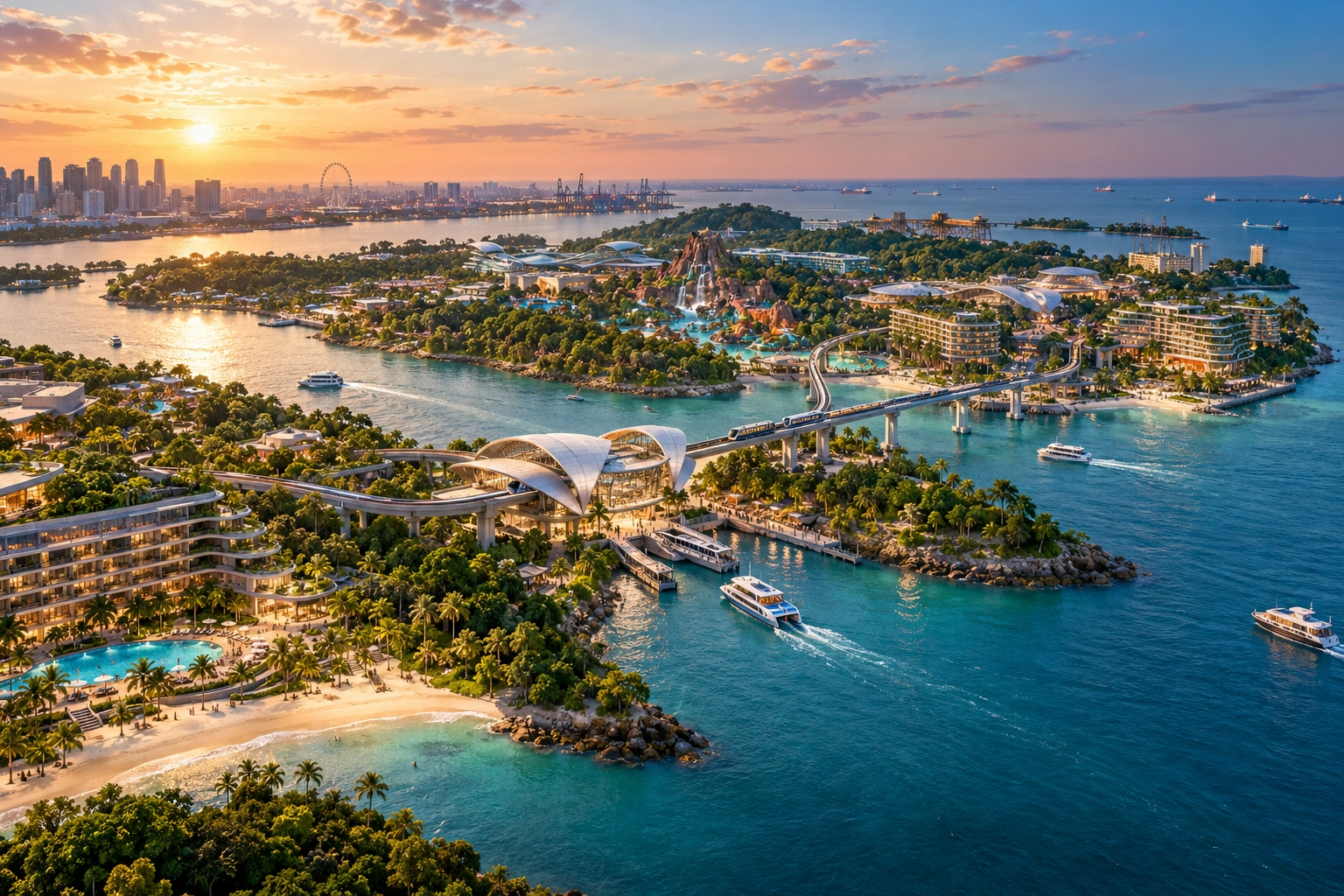
Most tourism master plans treat sustainability as a compliance requirement. Greater Sentosa treats it as a visitor-experience feature. The Cooling Sentosa Roadmap, unveiled in 2025, commits to bringing ambient temperatures down by at least 4°C across key outdoor zones through shade structures, misting systems, cool-paint coatings, and hydration points. At least ten cooling nodes are scheduled for installation before 2030. The first trial at Siloso Beach combined Nippon Paint COOL-TEC coatings, misting, and increased shade in a single public area.
Carbon Neutrality as the Baseline
SDC’s sustainability roadmap sets two parallel goals: carbon neutrality by 2030 and recognition as a globally certified sustainable tourism destination. The operational vehicle is the Sentosa Carbon Neutral Network, Singapore’s first carbon-neutrality-driven business alliance, which unites 31 businesses across the island in reducing greenhouse gas emissions through solar energy and green transport. The island has already committed to electrifying 100% of intra-island public transportation, a milestone that dovetails with the tram-based people-mover replacing the Sentosa Express.
Nature-Based Solutions and the Sensorium
The beachfront Sensorium, a planned anchor of the southern coast, is designed with shaded green spaces intended to improve thermal comfort while hosting indoor attractions and festival venues. This is sustainability as spatial strategy: by combining green infrastructure with commercial programming, SDC reduces the heat-island effect without sacrificing revenue-generating floor area.
The Real-World Test: Certification, Not Just Construction
Sentosa was conferred the GSTC-Destination certificate in 2022, giving it a credible external framework for measuring progress. The challenge is maintaining that certification while doubling visitor numbers. More visitors mean more transport movements, more waste, and more energy demand. The Carbon Neutral Network’s 31 members will need to reduce emissions in absolute terms, not merely intensity terms, if the 2030 target is to survive the growth mandated by the GSMP.
Author

Clara@gmail.com
Related Posts
Princess Cruises and Singapore’s Three-Year Partnership: A Blueprint for Cruise Industry Growth in Asia
- 0
- 477 words
A Landmark Partnership for Asian Cruising In May 2026, the Singapore Tourism Board and Princess Cruises announced a three-year partnership that represents...
Read out all
Science Centre Singapore and KidsSTOP: Building Scientific Curiosity Through Play-Based Learning
- 0
- 408 words
A Legacy of Interactive Science Education Since its establishment, Science Centre Singapore has stood as the nation’s premier institution for hands-on scientific...
Read out all
Gardens by the Bay Photography in 2026: A Complete Visual Guide for Travellers
- 0
- 382 words
Gardens by the Bay has welcomed over 87 million visitors since its opening, cementing its status as Singapore’s premier horticultural and photographic...
Read out all
The Architectural Time Machine: Tracing Singapore’s Evolution Through Its Most Iconic Modern Structures
- 0
- 499 words
To walk through Singapore is to flip through the pages of a futuristic novel that actually came true. The city’s modern architecture...
Read out all
Eating Like a King on a Pauper’s Budget: The Backpacker’s Guide to Singapore Hawker Centres
- 0
- 608 words
The reputation of Singapore as one of the most expensive cities in the world often deters budget travelers, but there is a...
Read out all
Singapore Remote Work Visa Options 2026: Tech.Pass, EntrePass, and Work Holiday Pass Explained
- 0
- 494 words
Many digital nomads assume Singapore offers a dedicated digital nomad visa. It doesn’t. Instead, the city-state uses a suite of targeted passes...
Read out all