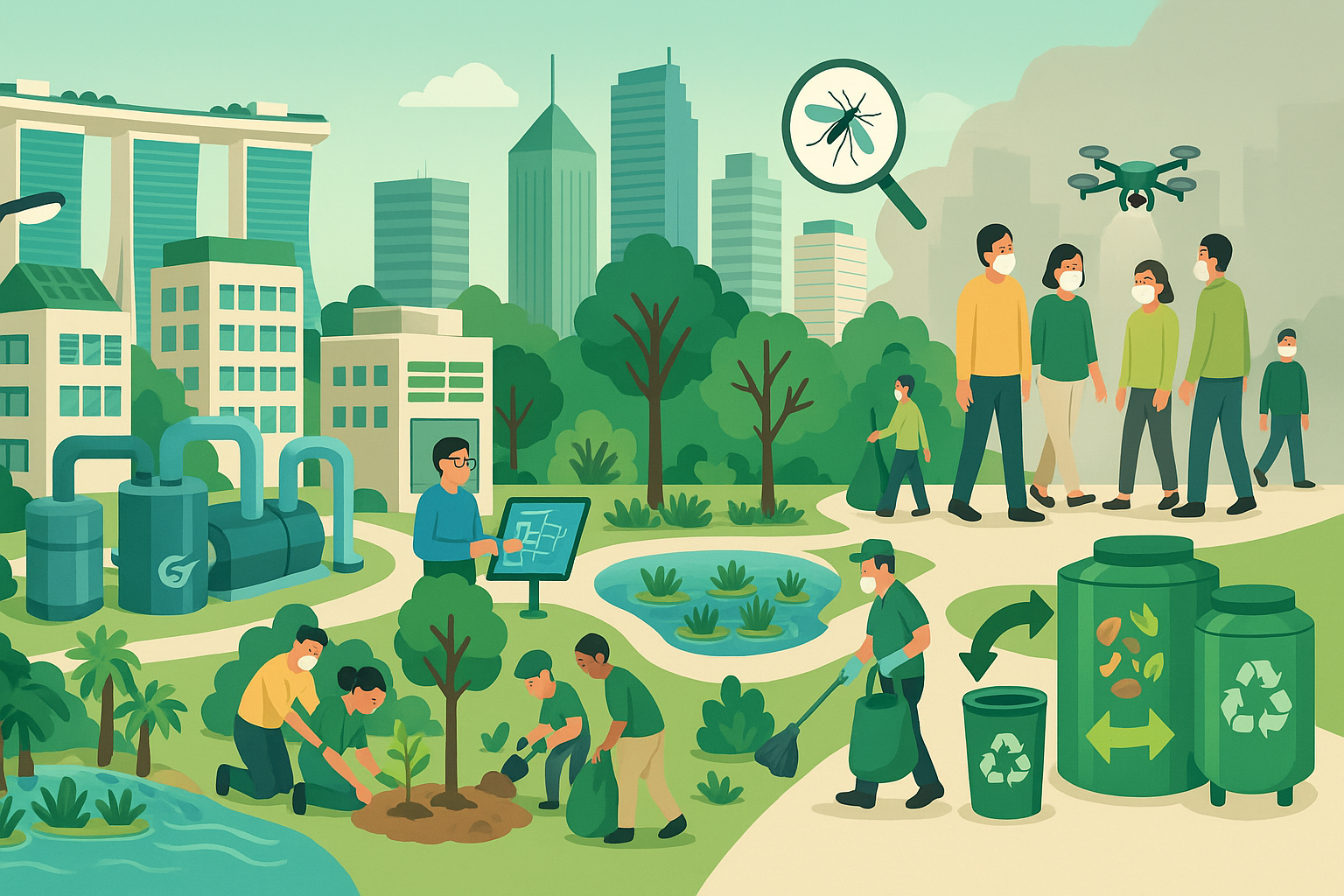
In Singapore, environmental policy is ultimately health policy. The city-state’s approach prioritizes human outcomes—fewer respiratory attacks, safer drinking water, cooler neighborhoods—by managing pollution at its sources and breaking transmission pathways for disease.
Start with the air we breathe. Traffic, industries, and construction are the key local emitters of particulate matter and nitrogen oxides. Controls span vehicle emissions standards, fuel quality, inspection regimes, and incentives for cleaner fleets, including hybrids and electric vehicles. Car-lite planning—dense, transit-oriented development and pedestrian networks—reduces exposure near roads. When smoke haze drifts in from regional fires, health advisories escalate stepwise: schools adjust outdoor activities, workers receive guidance based on PSI levels, and vulnerable groups are urged to limit exertion or use appropriate masks.
Water and sanitation form the next protective shield. With NEWater and desalination, supply security improves, but safety hinges on multi-barrier treatment and continuous monitoring for pathogens like E. coli and chemicals such as heavy metals and disinfection by-products. The ABC Waters design guidelines integrate vegetated swales and rain gardens that filter runoff, cutting urban pollutants before they reach reservoirs. Food safety is closely linked: clean water in hawker centres, temperature control, and NEA grading reduce gastrointestinal illness.
Waste management intersects with disease ecology. High-temperature incineration curbs odors and pests while recovering energy. The Zero Waste Masterplan advances circularity: producer responsibility for e-waste, packaging reduction, and food waste valorisation. Better material recovery translates to cleaner neighborhoods, fewer vermin, and diminished vector habitats.
Vector control is relentless because dengue is endemic. Public health teams map cases in near real time, issue color-coded cluster alerts, and conduct inspections with penalties for breeding sites. Community habits—clearing trays, tightly closing bins, “turn over, tip out” water containers—are simple yet powerful. Healthcare providers coordinate on rapid testing and supportive care to prevent severe dengue, keeping case fatality low.
The urban heat island compounds health burdens by raising ozone formation and stressing the cardiovascular system. Singapore counters with tree canopy expansion, shaded walkways, reflective and green roofs, and district-level cooling. Building codes emphasise ventilation and energy efficiency to keep indoor environments safe during hot spells, especially for seniors.
Governance and culture amplify impact. The SG Clean quality mark, public dashboards for PSI and dengue clusters, and clear penalties for littering reinforce norms. Economic instruments matter too: a rising carbon tax and energy efficiency standards shift behavior upstream, preventing emissions rather than merely treating symptoms downstream.
Looking ahead, climate change increases volatility: wetter wet seasons, hotter dry spells, and higher regional fire risk. Singapore’s resilience strategy—nature-based drainage, diversified water, circular materials, and health-centric urban design—keeps the focus on people, ensuring that cleaner environments directly translate to fewer clinic visits, lower hospitalisations, and better quality of life.
Author

Clara@gmail.com
Related Posts

The HELIOS Study and the Multi-Omic Future of Asian Health Research
- 0
- 376 words
Beyond the Single-Layer Genome Most genomic studies examine one biological layer at a time. The Health for Life in Singapore (HELIOS) study...
Read out all
Turmeric, Ginseng, and Echinacea—The Three Botanicals Reshaping Singapore’s Supplement Aisle
- 0
- 583 words
The Turmeric Takeover Walk into any Guardian, Watsons, or Unity pharmacy in Singapore, and the dominance of turmeric is unmistakable. Curcumin capsules,...
Read out all
Cancer Screening Crisis in Singapore’s Malay Community Exposes Deeper Health Equity Failures
- 0
- 520 words
A Preventable Crisis Singapore’s National Population Health Survey 2025 delivered a sobering verdict on cancer screening equity: Malay women have the lowest...
Read out all
The Nursing Exodus: Why Singapore’s Local Nurses Are Leaving and What It Will Take to Keep Them
- 0
- 650 words
The Silent Drain on Singapore’s Healthcare Frontline Behind the polished corridors of Singapore’s public hospitals, a quiet crisis is unfolding. Over half...
Read out all
NTU Singapore’s Microscopic Peptide Droplets Slash Colorectal Tumour Growth by 67%
- 0
- 352 words
A New Approach to an Old Problem Colorectal cancer remains one of the most challenging malignancies to treat, particularly when tumours develop...
Read out all
Plant Protein Powders and Functional RTDs Are Redefining Singapore’s Urban Supplement Culture
- 0
- 395 words
At 8 a.m. in Singapore’s Central Business District, the breakfast crowd is no longer just ordering kopi and toast. Many are grabbing...
Read out all