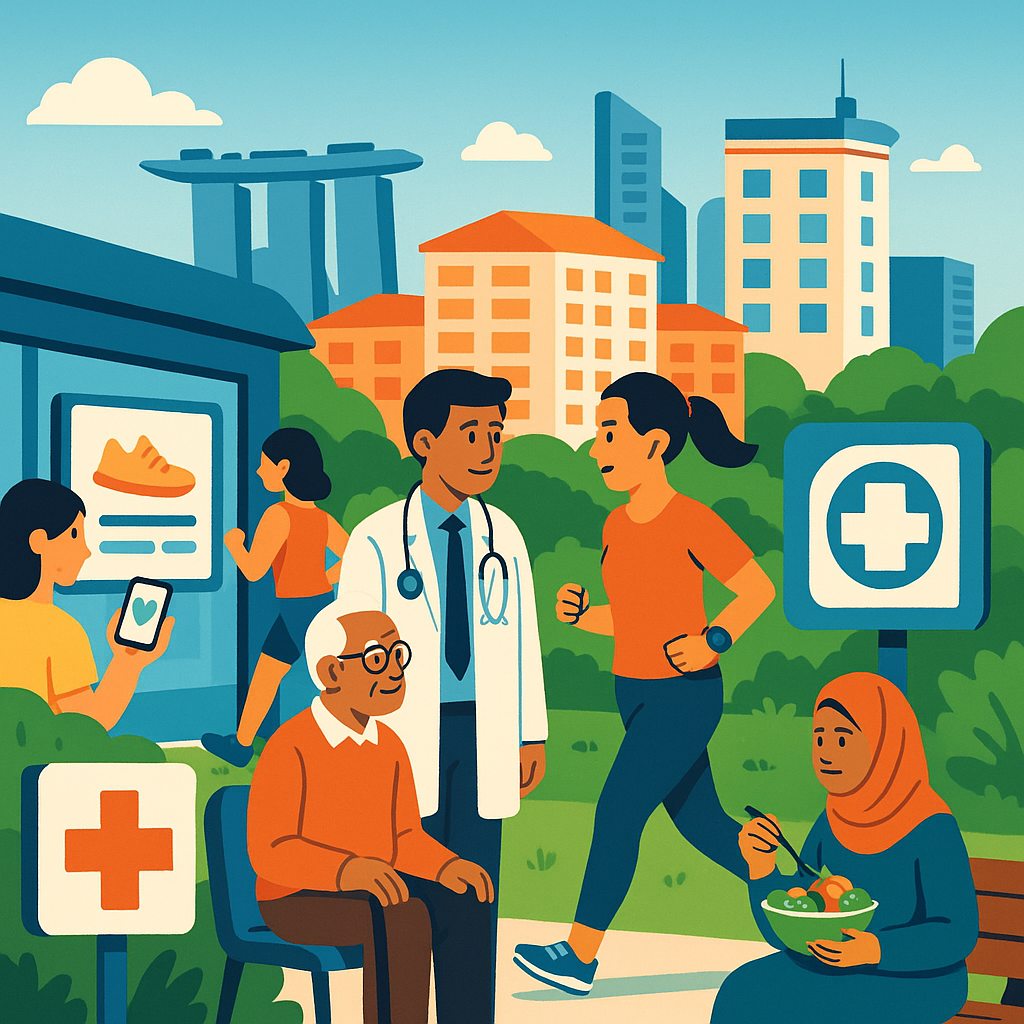
Public health in Singapore is not left to chance. The government deliberately designs structures and policies that influence how people fall ill, how quickly they receive care, and how well they recover. From the way hospitals are run to the messages on billboards, the state’s presence is evident across the entire health landscape.
At the top of the system stands the Ministry of Health, which functions as the chief planner and regulator. It decides overall strategy, drafts rules for healthcare providers, and monitors the performance of hospitals and clinics. Together with other agencies, it analyses population data to identify trends: where chronic diseases are rising, which groups struggle with access, or how lifestyle habits are changing. These insights are then translated into policies, such as national screening programmes or targeted subsidies.
Financing is another domain in which the government has a firm hand. Singapore’s model encourages individuals to save for their own medical expenses, but the state steps in through subsidised care, insurance schemes, and support for those unable to pay. Public hospitals and polyclinics receive government funding so that fees can be kept lower than in many purely market-based systems. This approach reflects a philosophy that people should be responsible for their health, but the community as a whole should protect those in need.
The government also exerts direct control through the operation of public healthcare institutions. Large hospital groups and regional health systems are generally government-linked, and they carry significant responsibility for delivering services that are in the public interest. Polyclinics provide primary care, vaccinations, and screenings at affordable rates. Initiatives to integrate care mean that patients with chronic diseases can be managed in the community instead of repeatedly turning up at emergency departments.
Prevention is a major area in which Singapore’s government is particularly active. The Health Promotion Board, for example, coordinates campaigns on smoking, physical activity, diet, and mental wellness. It collaborates with schools to educate children, with employers to support healthy workplaces, and with community organisations to reach vulnerable groups. Rather than relying solely on one-off messages, the campaigns often combine education, incentives, and environmental changes—such as easier access to healthier food options.
In the arena of infectious diseases, the government has developed strong legal and operational tools. Certain conditions must be reported to health authorities, enabling early detection of outbreaks. When serious threats emerge, authorities can implement contact tracing, isolation measures, and border controls. Specialised facilities, laboratory capacity, and coordinated communication help ensure that responses are swift and organised. Past experiences with epidemics have pushed various ministries and agencies to practise working together under stress.
At the same time, the government is increasingly focused on complex, long-term issues. An older population, growing mental health needs, and rising healthcare costs require fresh approaches. Policy shifts emphasise keeping people healthy in the community for as long as possible, instead of relying heavily on hospital-based care. Digital technology, telehealth, and data analytics are being woven into strategies to make services more accessible and efficient. Through all of this, Singapore’s government continues to act as strategist, funder, regulator, and communicator, deeply shaping the public’s health journey from cradle to old age.
Author

Clara@gmail.com
Related Posts

The HELIOS Study and the Multi-Omic Future of Asian Health Research
- 0
- 376 words
Beyond the Single-Layer Genome Most genomic studies examine one biological layer at a time. The Health for Life in Singapore (HELIOS) study...
Read out all
Turmeric, Ginseng, and Echinacea—The Three Botanicals Reshaping Singapore’s Supplement Aisle
- 0
- 583 words
The Turmeric Takeover Walk into any Guardian, Watsons, or Unity pharmacy in Singapore, and the dominance of turmeric is unmistakable. Curcumin capsules,...
Read out all
Cancer Screening Crisis in Singapore’s Malay Community Exposes Deeper Health Equity Failures
- 0
- 520 words
A Preventable Crisis Singapore’s National Population Health Survey 2025 delivered a sobering verdict on cancer screening equity: Malay women have the lowest...
Read out all
The Nursing Exodus: Why Singapore’s Local Nurses Are Leaving and What It Will Take to Keep Them
- 0
- 650 words
The Silent Drain on Singapore’s Healthcare Frontline Behind the polished corridors of Singapore’s public hospitals, a quiet crisis is unfolding. Over half...
Read out all
NTU Singapore’s Microscopic Peptide Droplets Slash Colorectal Tumour Growth by 67%
- 0
- 352 words
A New Approach to an Old Problem Colorectal cancer remains one of the most challenging malignancies to treat, particularly when tumours develop...
Read out all
Plant Protein Powders and Functional RTDs Are Redefining Singapore’s Urban Supplement Culture
- 0
- 395 words
At 8 a.m. in Singapore’s Central Business District, the breakfast crowd is no longer just ordering kopi and toast. Many are grabbing...
Read out all